Fixed fire-fighting systems
CO₂, clean agent, foam, water mist, sprinkler and galley systems: content checks, release and alarm tests, blow-through, and cylinder requalification.
Why it matters
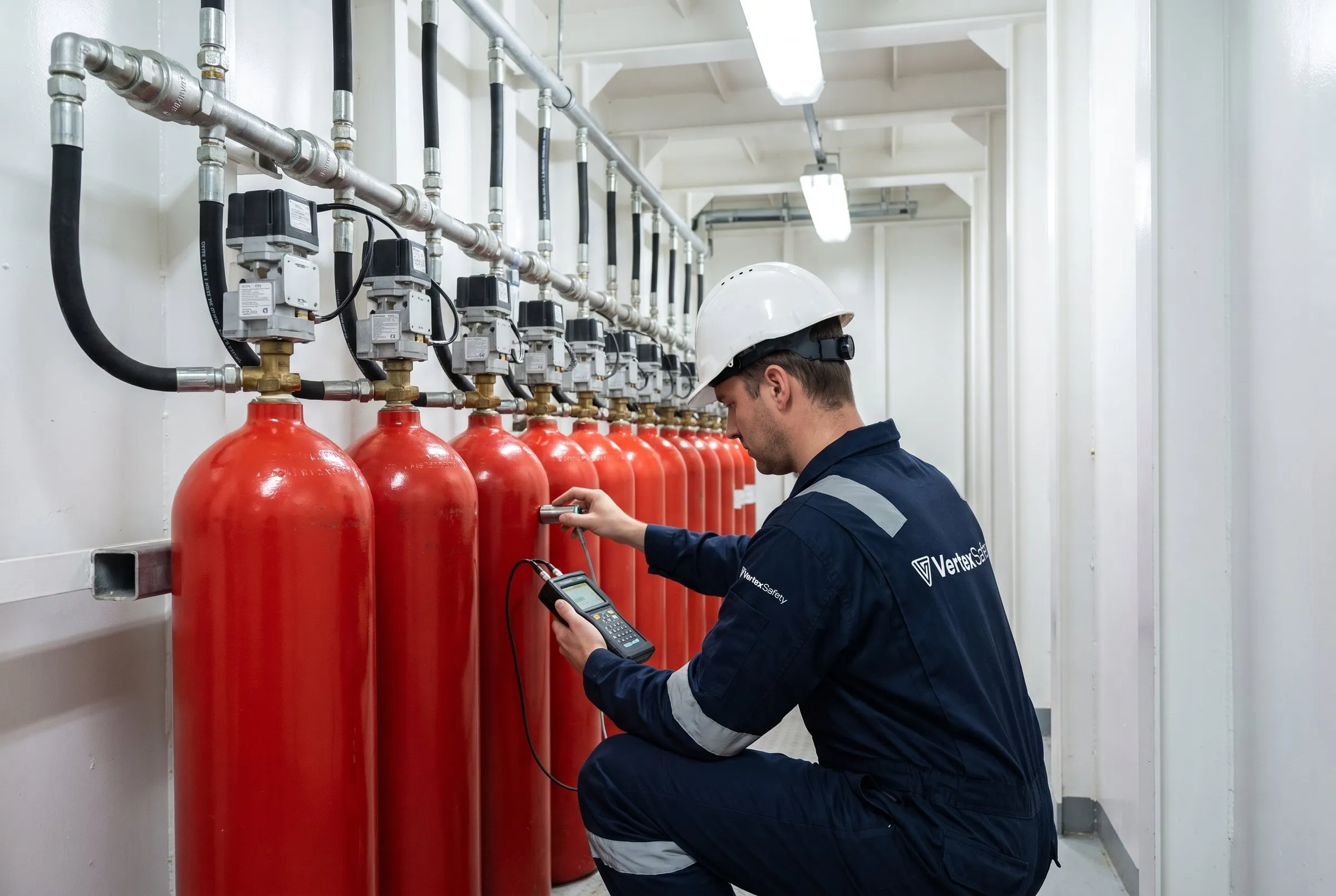
A fixed system is what stands between an engine-room fire and losing the ship. It can sit unused for a decade, so the only way to know it will work is a proper annual service by people who know the system.
We test without discharging the agent wherever the rules allow, and we tell you early when cylinders or hoses approach their ten-year marks, so those costs never come as a surprise.
What we do
Scope of work
- 01
High-pressure CO₂
Content of every cylinder measured by liquid-level indicator or weighing, release controls, time delay and alarms, main and distribution valves, flexible hoses and blow-through of the pipework.
- 02
Low-pressure CO₂
Tank level gauges, refrigeration units, safety valves and release arrangements.
- 03
Clean agent and inert gas
HFC, FK-5-1-12 and inert gas systems: content and pressure checks, actuators, nozzles and room integrity questions.
- 04
Foam systems
Proportioners, valves, monitors and generators, plus the foam concentrate sample for laboratory analysis.
- 05
Water mist and sprinklers
Pumps, pressure tanks, section valves, nozzles and alarms, with flow and function tests.
- 06
Galley and local application
Hood and deep-fat fryer systems, and local application water mist in machinery spaces.
- 07
Dry powder systems
Fixed dry powder systems on gas carriers: cylinders, propellant, nozzles and a powder sample checked for moisture and caking.
- 08
Halon and phased-out agents
Removal of halon and other phased-out agents, handed over for certified recovery or destruction.
- 09
Cylinders
Recharging, hydrostatic testing and requalification, with traceable records per cylinder.
Intervals
When it is due
Typical intervals under the IMO instruments listed. Your flag, class or the maker's manual can ask for more; we check before we quote.
| Item | Interval | Basis |
|---|---|---|
| Annual inspection | 12 months | MSC.1/Circ.1432 (CO₂: MSC.1/Circ.1318/Rev.1) |
| CO₂ content check (refill below 90 %) and blow-through of the piping | Every 2 years ± 3 months on passenger ships; at each intermediate, periodical or renewal survey on cargo ships | MSC.1/Circ.1318/Rev.1 |
| Internal inspection of CO₂ control valves | 5 years | MSC.1/Circ.1318/Rev.1 |
| Hydrostatic test of high-pressure CO₂ cylinders | At least 10 % (pilot cylinders included) at 10 years; all cylinders by the 20th year and every 10 years after | MSC.1/Circ.1318/Rev.1 |
| Flexible hoses | Renewed at the maker's interval, at most every 10 years | MSC.1/Circ.1318/Rev.1 |
| Foam concentrate analysis | First within 3 years of supply, then every year | MSC.1/Circ.1312, MSC/Circ.670 |
What you get
- Certificate per system, listing every cylinder by serial and content
- Cylinder test and requalification records
- Service report signed on board by the Master or Chief Officer
- Photos and plain notes on every unit that failed, with a quote for the fix
- Next due dates in your customer portal
Rules we work to
- SOLAS II-2/10
- SOLAS II-2/14
- FSS Code ch. 5, 6 and 7
- MSC.1/Circ.1432
- MSC.1/Circ.1318/Rev.1
- MSC.1/Circ.1312
- IACS UR Z17
- ISO 15371
References are summaries for planning. The current text of each instrument, your flag's interpretation and the maker's instructions always apply.
Questions
Asked on board
Do you have to discharge the CO₂ to test the system?
No. Cylinder content is measured with an ultrasonic liquid-level indicator or by weighing, and release lines, time delays and alarms are tested without releasing the agent.
Our cylinders are coming up to ten years. What does that mean?
At ten years at least 10 % of the high-pressure cylinders, pilot cylinders included, are hydrostatically tested; one failure means 50 %, a further failure means all of them. By the twentieth year every cylinder must have been tested, and every ten years after that. Under the Dutch flag all cylinders must comply by the next dry-docking and by 1 January 2028 at the latest. We plan the work so the required quantity of CO₂ stays available while cylinders are away.
Technical information
- Fixed CO₂ systems: what is checked monthly, every two, five, ten and twenty yearsThe maintenance schedule for fixed CO₂ fire-extinguishing systems under MSC.1/Circ.1318/Rev.1, the cylinder testing regime, the Dutch flag deadline and the safety rules for working on the system.
- PFOS foam ban on ships: what to do before your next surveySince 1 January 2026 SOLAS bans fire-extinguishing media containing PFOS. What counts, how flag and class check it, and the order of work for replacing the foam.
Often booked together
Request service
Book it for the next port call.
A vessel name, an IMO number and an ETA are enough to get a quote moving. Attach last year's certificates if you have them.