Liferafts and hydrostatic release units
Liferaft servicing at an approved service station, HRU testing and replacement, and exchange rafts arranged when the ship cannot wait.
Why it matters
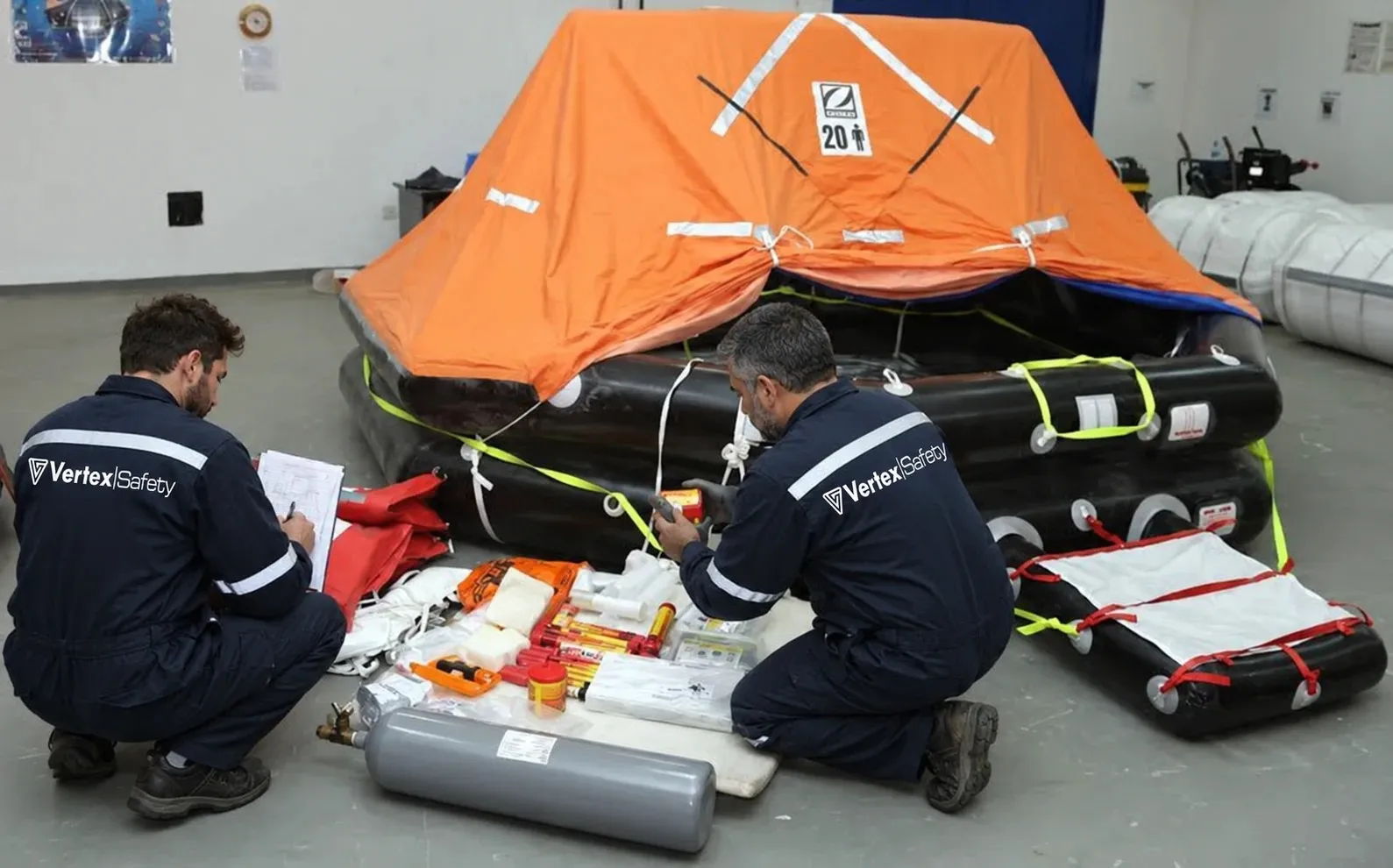
A liferaft spends its life packed in a canister on deck, in salt, sun and frost. The annual service is the only moment anyone sees what is inside, which is why it has to be done at an approved service station, to the maker's procedures, and never on the quay.
We take the rafts off the ship, service them and bring them back, and we keep an eye on the dates that are easy to miss: the hydrostatic release unit, the pyrotechnics in the pack and the inflation cylinder's next test.
What we do
Scope of work
- 01
Collection and refitting
Canisters lifted off their cradles, painters and HRUs disconnected and reconnected correctly on return, with a check of the stowage and lashings.
- 02
Inflation and pressure tests
Working pressure test at every service, a gas inflation test every five years, and the necessary additional pressure (NAP) and floor seam tests at every service once the raft is more than ten years old.
- 03
Equipment pack
Every item checked against the LSA Code list: flares, water, rations, first-aid kit, torch and batteries. Anything that would expire before the next service is replaced.
- 04
Inflation cylinder
Gas content checked against the maker's limits, valve and head serviced, cylinder sent for hydrostatic testing when due.
- 05
Hydrostatic release units
Serviceable HRUs tested; disposable units replaced before the expiry date marked on them.
- 06
Davit-launched rafts
Release hook and launching arrangement checked together with the davit service, and the raft overload-tested at every second service, so the whole system is covered.
- 07
Marine evacuation systems
Evacuation slides and chutes on passenger ships and ferries serviced at an approved station, including the rotational deployments the rules call for.
Intervals
When it is due
Typical intervals under the IMO instruments listed. Your flag, class or the maker's manual can ask for more; we check before we quote.
| Item | Interval | Basis |
|---|---|---|
| Inflatable liferaft service | 12 months; the flag may allow up to 17 months where servicing is impracticable | SOLAS III/20.8.1 |
| Extended-service-interval liferafts (accepted by the flag) | Service up to every 30 months in the first 10 years, plus an annual on-board inspection by maker-certified staff | SOLAS III/20.8.3, MSC.1/Circ.1328 |
| Hydrostatic release unit, serviceable type | 12 months; the flag may allow up to 17 months | SOLAS III/20.9 |
| Disposable HRU | Replace by the expiry date marked on the unit | LSA Code 4.1.6.3.8, maker |
| Gas inflation test | Every 5 years | Res. A.761(18) |
| NAP and floor seam tests | At every service once the raft is more than 10 years old | Res. A.761(18) as amended |
What you get
- Liferaft service certificate for each raft
- HRU certificate or new HRU with its expiry date
- Updated list of pack items and their expiry dates
- Photos and plain notes on every unit that failed, with a quote for the fix
- Next due dates in your customer portal
Rules we work to
- SOLAS III/20.8
- SOLAS III/20.9
- LSA Code 4.1 and 4.2
- Res. A.761(18) as amended
- MSC.1/Circ.1328
- MSC/Circ.955
References are summaries for planning. The current text of each instrument, your flag's interpretation and the maker's instructions always apply.
Questions
Asked on board
Can a liferaft be serviced on board?
No. SOLAS requires servicing at an approved service station. The one exception is the annual on-board inspection of extended-service-interval rafts, done by staff certified by the maker. Otherwise we check the stowage, the HRU and the painter connection on board.
What if the ship sails before the raft is back?
Tell us early. Where the schedule is tight we arrange an exchange raft of the same type and capacity, so the ship never sails short.
Often booked together



Request service
Book it for the next port call.
A vessel name, an IMO number and an ETA are enough to get a quote moving. Attach last year's certificates if you have them.