Foam analysis and PFOS-free conversion
Periodic foam testing, and the full switch to PFOS-free foam: removal, cleaning, refilling and the documents the surveyor will ask for.
Why it matters
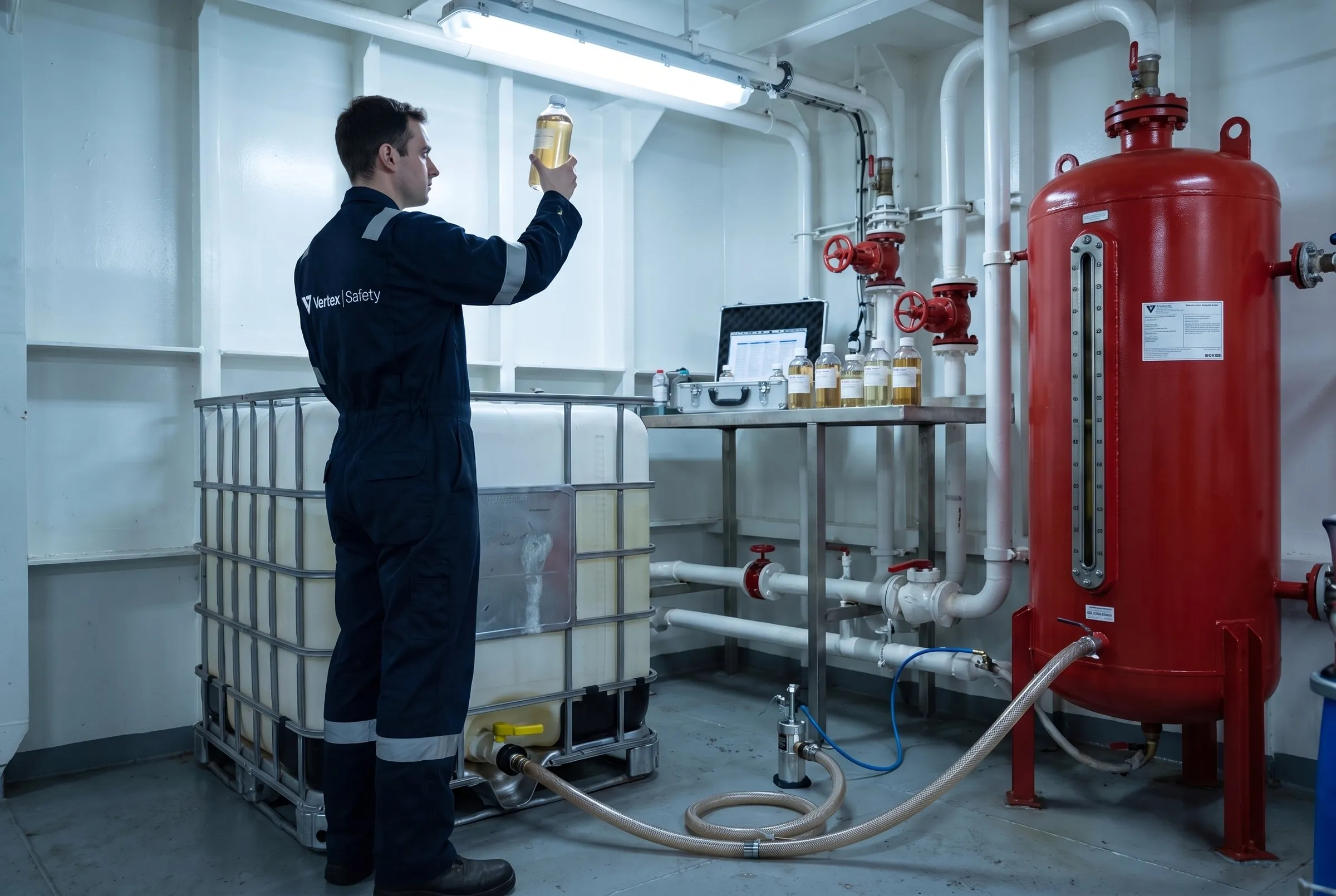
Since 1 January 2026, SOLAS no longer allows fire-extinguishing media that contain PFOS (more than 10 mg/kg). Ships whose keel is laid on or after that date may not use or store it at all, and existing ships have to be clear of it by their first survey on or after that date. On many older ships the foam tank still holds the original concentrate.
The flag or class checks this through the maker's declaration or a laboratory report, so the paperwork matters as much as the foam. We take care of the whole change: testing, removal, cleaning, refilling and the documents.
What we do
Scope of work
- 01
Document check
We start with what you have: fixed tanks, portable foam applicators and foam extinguishers, with maker, batch and certificates. Often that settles the question; if not, we test.
- 02
Sampling and analysis
Samples taken from the tank and sent to an accredited laboratory for PFOS content and the usual performance parameters.
- 03
Removal and disposal
Old concentrate pumped out, collected and handed over for disposal ashore, with the waste documents for your records.
- 04
Cleaning
Tank, proportioner and lines flushed, so residues do not end up in the new foam.
- 05
Refill
PFOS-free concentrate that suits your system: the right type, proportioning rate and approval, not just the cheapest drum.
- 06
Paperwork
The maker's original PFOS-free declaration, test reports and disposal records, plus the details for your logbook entry and IHM update.
Intervals
When it is due
Typical intervals under the IMO instruments listed. Your flag, class or the maker's manual can ask for more; we check before we quote.
| Item | Interval | Basis |
|---|---|---|
| PFOS-containing foam removed (existing ships) | By the first survey on or after 1 January 2026 | SOLAS II-2, Res. MSC.532(107) |
| Proof that the foam is PFOS-free (declaration or lab report) | New ships at delivery; existing ships by the first survey on or after 1 January 2026 | SOLAS II-2/10.11, MSC.1/Circ.1694 |
| Low-expansion foam concentrate analysis | First within 3 years of supply to the ship, then every year | MSC.1/Circ.1312 |
| High-expansion foam concentrate analysis | First after 3 years, then every year | MSC/Circ.670 |
What you get
- Laboratory report on the old and new concentrate
- Maker's PFOS-free declaration, as issued by the maker
- Disposal record for the removed foam
- Service report signed on board by the Master or Chief Officer
- Photos and plain notes on every unit that failed, with a quote for the fix
Rules we work to
- SOLAS II-2/1 and II-2/10
- Res. MSC.532(107)
- Res. MSC.536(107) and MSC.537(107) (HSC)
- MSC.1/Circ.1694
- MSC.1/Circ.1312
- MSC/Circ.670
References are summaries for planning. The current text of each instrument, your flag's interpretation and the maker's instructions always apply.
Questions
Asked on board
Can we simply top up with PFOS-free foam?
No. Mixing leaves PFOS in the system, and many foams are not compatible with each other. The old concentrate has to come out and the system has to be cleaned first.
Will a fluorine-free foam work in our system?
Sometimes, but not always. Fluorine-free foams can need different proportioning and are not approved for every application. We check your system design before we recommend one.
Is PFOS-free the same as PFAS-free?
No. SOLAS bans PFOS only; other fluorinated foams are still allowed under SOLAS. The EU is phasing out PFAS in fire-fighting foams under Regulation (EU) 2025/1988, so when the foam has to be replaced anyway, a fluorine-free foam is worth considering.
Often booked together


Request service
Book it for the next port call.
A vessel name, an IMO number and an ETA are enough to get a quote moving. Attach last year's certificates if you have them.