Lifeboats, rescue boats and davits
Annual thorough examinations of lifeboats, rescue boats, davits and release gear, the five-yearly release gear overhaul and winch proof-load test, and wire renewals.
Why it matters
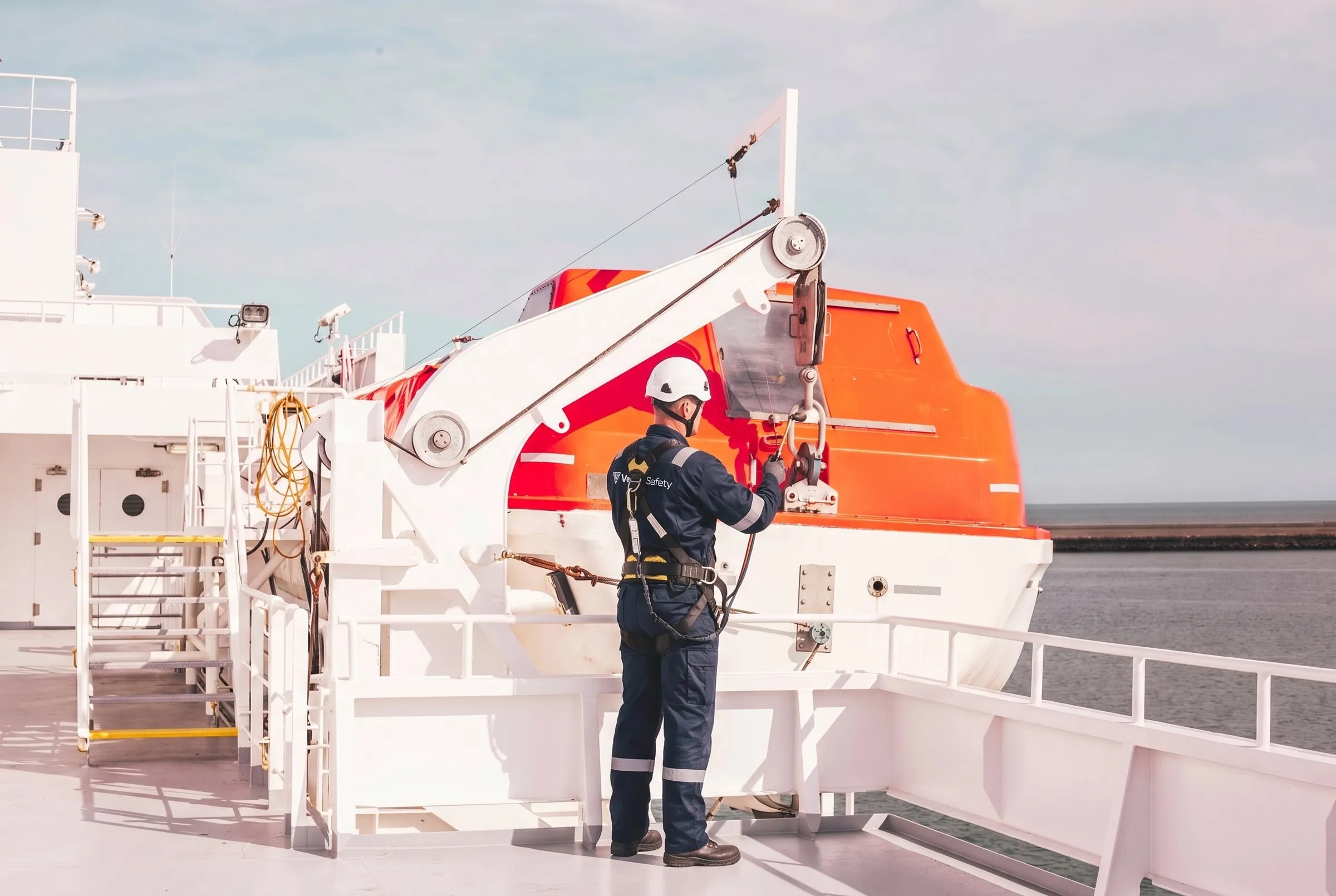
IMO recorded many seafarers injured or killed in lifeboat drills and inspections, through release gear failures, poor maintenance and unfamiliar equipment. That is why MSC.402(96), mandatory since 1 January 2020, defines who may examine lifeboats, davits and release gear, and how: certified technicians of authorised service providers, working to the maker's instructions.
We carry out the annual thorough examination and the five-yearly overhaul and load tests, and we leave the crew a short, practical list of what to watch until the next visit.
What we do
Scope of work
- 01
Annual thorough examination
Hull, fittings, seats and harnesses, engine and steering, the ventilation system (required since 2026), water spray and air supply on tanker boats, and the boat's equipment, followed by an operational test.
- 02
On-load release gear
Examination and operational test of hooks, release cable and interlocks every year; complete overhaul every five years, with a load test at 1.1 times the boat's total mass with full complement and equipment.
- 03
Davits and winches
Structure, sheaves, limit switches, brakes and remote control checked, with a dynamic brake test at full lowering speed with the empty boat every year. Every five years the brake is tested with 1.1 times the mass of the boat with full complement and equipment, with a surveyor attending.
- 04
Falls
Wires inspected and renewed within five years, or earlier when worn, with new wire certificates.
- 05
Rescue boats and free-fall boats
The same care for rescue boats, including inflatable tubes and outboard engines, and for free-fall release and simulated launching arrangements.
- 06
Engines, hulls and retrofits
Lifeboat engine service, GRP repairs, air and spray systems, and replacement of release hooks that no longer meet the current rules.
Intervals
When it is due
Typical intervals under the IMO instruments listed. Your flag, class or the maker's manual can ask for more; we check before we quote.
| Item | Interval | Basis |
|---|---|---|
| Thorough examination and operational test | Every year, at the annual survey | SOLAS III/20.11, MSC.402(96) |
| Release gear overhaul and test at 1.1 times the fully loaded boat | 5 years, with a surveyor attending | SOLAS III/20.11.2, MSC.402(96), MSC.1/Circ.1618 |
| Winch dynamic brake test with the empty boat | Every year | SOLAS III/20.11.1 |
| Winch brake proof-load test (1.1 times boat, full complement and equipment) | 5 years | SOLAS III/20.11.1, MSC.402(96) |
| Falls renewed | 5 years, or earlier when deteriorated | SOLAS III/20.4 |
What you get
- Annual or five-yearly certificate for boat, davit, winch and release gear
- Report of examination signed by the technician and countersigned by the Master or the Company's representative
- Statement that the arrangements remain fit for purpose, with copies of the technician's certificate and the service provider's authorisation
- Load test certificate with the test weights used
- Wire certificates for renewed falls
- Photos and plain notes on every unit that failed, with a quote for the fix
- Next due dates in your customer portal
Rules we work to
- SOLAS III/20
- LSA Code ch. IV and VI
- Res. MSC.402(96)
- Res. MSC.559(108)
- MSC.1/Circ.1578/Rev.1
- MSC.1/Circ.1618
- MSC.1/Circ.1392
References are summaries for planning. The current text of each instrument, your flag's interpretation and the maker's instructions always apply.
Questions
Asked on board
Who is allowed to examine our lifeboats?
Under MSC.402(96), technicians certified for that make and type, working for a service provider authorised by the flag Administration (or accepted by it through a recognised organisation or another Administration). Manufacturers acting as service providers must meet the same requirements. Ask for the authorisation and the technician's certificate before the work starts.
Do you need the boat in the water?
The operational test means lowering the boat. We agree the timing with the terminal and the agent; where a port does not allow it, we plan the test for the next suitable call.
Often booked together


Request service
Book it for the next port call.
A vessel name, an IMO number and an ETA are enough to get a quote moving. Attach last year's certificates if you have them.